For Midwest food and beverage manufacturers, CPG brands, and the packaging and ingredient suppliers that support them, seasonal inventory swings aren’t a planning failure – they’re a structural feature of the business. Soup manufacturers build ahead of colder months. Frozen food volumes rise around major holidays. Packaging suppliers ramp up in anticipation of retail promotions. Baking and specialty food categories accelerate into Q4.
The trap isn’t the seasonality. It’s what companies do about it.
Many organizations run warehouse strategies designed for consistency rather than variability – facilities sized for average demand, infrastructure built for the baseline, not the spike. When peak volume arrives, the network that worked fine in June starts showing cracks in October. And by then, the best Midwest warehouse options are already gone.
As peak seasons grow more compressed and retail planning cycles continue to push earlier, supply chain leaders are being forced to make warehousing decisions further in advance than their organizations are accustomed to. The window between “we should look at this” and “we needed to decide two months ago” is narrowing.
Particularly in the Midwest, where capacity is structurally constrained and seasonal demand is concentrated, that timing gap has real operational consequences.
Peak Season Planning Starts Earlier Than Most Operations Teams Act On It
The organizations that navigate peak periods most effectively aren’t the ones reacting to capacity constraints in September – they’re the ones that identified where their network had gaps in Q2 or Q3 and moved before the market tightened.
This matters more in Chicago than almost anywhere else. Chicago’s industrial market entered 2026 at approximately 4.8% overall vacancy – one of the tightest CBRE readings among major U.S. logistics markets – with the O’Hare corridor anchoring the northwest suburban region at just 2.9%.
New industrial supply in Chicago has been running well below the national average for years, while leasing demand continues to accelerate. The math on available flex capacity doesn’t favor companies that wait until August to start the conversation.
The Hidden Cost of Solving a Seasonal Problem With Permanent Infrastructure
When capacity constraints emerge, the instinct is to pursue more space – expand the existing facility, sign another lease, invest in labor infrastructure. For companies experiencing sustained growth, that may be the right call.
But for companies experiencing variability, permanent infrastructure creates its own problems. Fixed costs don’t flex with demand. A facility running at full utilization in Q4 may sit 40% empty in Q1. Labor commitments made for peak volume become overhead when volume subsides.
What operations leaders increasingly need isn’t more square footage. It’s the ability to scale inventory capacity without taking on fixed infrastructure risk. Those are meaningfully different asks – and the traditional warehouse model wasn’t designed to answer the second one.
Why Midwest Positioning and Flexibility Go Together
For companies serving national retail and grocery customers, the Midwest remains one of the most strategically important inventory positioning regions in the country. Chicago’s concentration of food manufacturers, co-manufacturers, packaging suppliers, and ingredient providers – all feeding the same national retail networks – means that inventory positioning decisions here influence transportation efficiency and supply chain resilience in ways that decisions made elsewhere don’t.
Geographic strategy and warehousing strategy are increasingly the same decision.
Being positioned inside the right freight corridor – with access to the right interstates, manufacturing proximity, and distribution reach – can be the difference between a supply chain that absorbs seasonal demand and one that buckles under it.
In a multi-client 3PL environment, operational flexibility means adjusting capacity commitments as business requirements evolve: scaling pallet volume up during peak season without building permanent infrastructure, scaling back down without carrying fixed costs through slow periods.
It means supporting promotional builds and short-window inventory surges without requiring dedicated facility space. For companies navigating Q4 retail cycles, holiday inventory builds, or fluctuating co-manufacturing volumes, that adaptability is the structural answer to a problem permanent infrastructure consistently fails to solve cleanly.
The goal isn’t to eliminate variability. The goal is designing a network that can absorb it without sacrificing service levels, profitability, or future flexibility.
Des Plaines, IL: Built for This
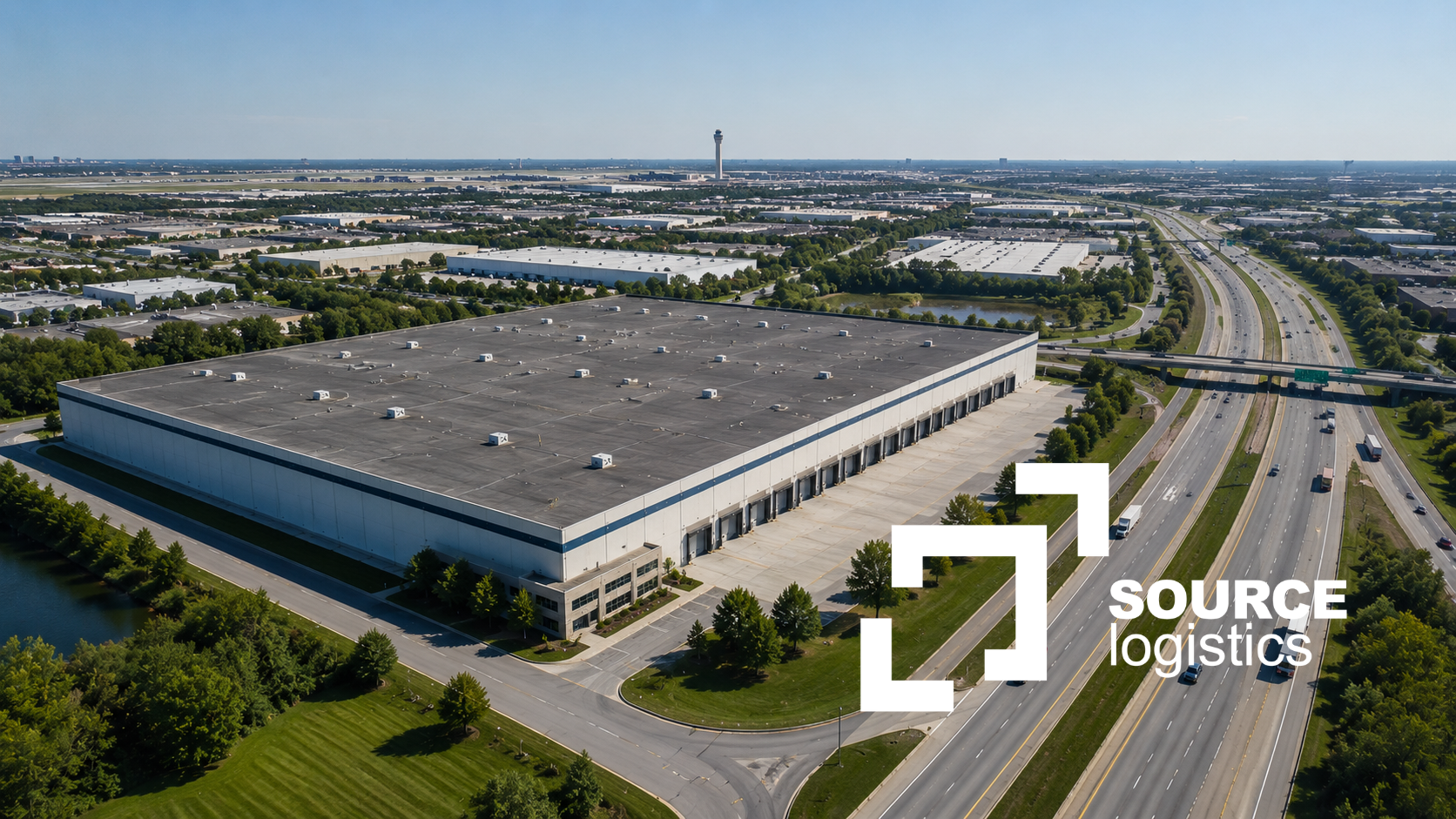
Source Logistics’ Des Plaines facility offers approximately 515,000 sq. ft. of warehouse capacity serving food, beverage, CPG, and related industries inside one of the Chicago metro’s most critical freight corridors – with direct access to:
That positioning supports efficient inventory movement throughout the Midwest and distribution to the lower 48 without the congestion and cost premium of more constrained inner-market locations.
The facility operates as a multi-client environment, meaning customers scale around actual pallet volume rather than dedicated square footage.
For food manufacturers, CPG brands, packaging and corrugate suppliers, and organizations supporting Midwest retail and production networks, it’s designed to absorb the fluctuations that define the segment:
- Seasonal volume spikes
- Overflow during facility transitions
- Variable pallet counts that don’t justify a dedicated footprint
- Promotional builds with short planning windows
Think of a Midwest soup manufacturer running 3,000 pallets of base inventory that swells to 5,000-plus ahead of winter retail programs – or a corrugate supplier whose volumes spike in direct correlation with a major food brand’s Q4 promotional calendar. Neither operation justifies a dedicated facility. Both need a reliable Midwest partner that can absorb the swing without requiring a long-term commitment to support it.
The objective isn’t simply finding additional square footage. It’s having a Midwest warehousing partner that flexes with your business, rather than one that requires your business to flex around a fixed infrastructure commitment.
The Companies That Navigate Q4 Well Are Already Planning
Retailers and grocery chains are setting inventory plans now. Production schedules are being finalized. If your warehouse network has a seasonal constraint – or you’re not certain whether it does – now is the right window to find out. Not September, when the conversation shifts from “what are our options” to “what’s still available.”
If your organization is evaluating Midwest flex capacity for peak season, managing overflow, or navigating a network in transition, we’d welcome the conversation about our Des Plaines warehouse, our seven other Chicagoland warehouses, or our 20+ warehouse nationwide.
Connect with our team to discuss what that looks like for your operation.
.png)