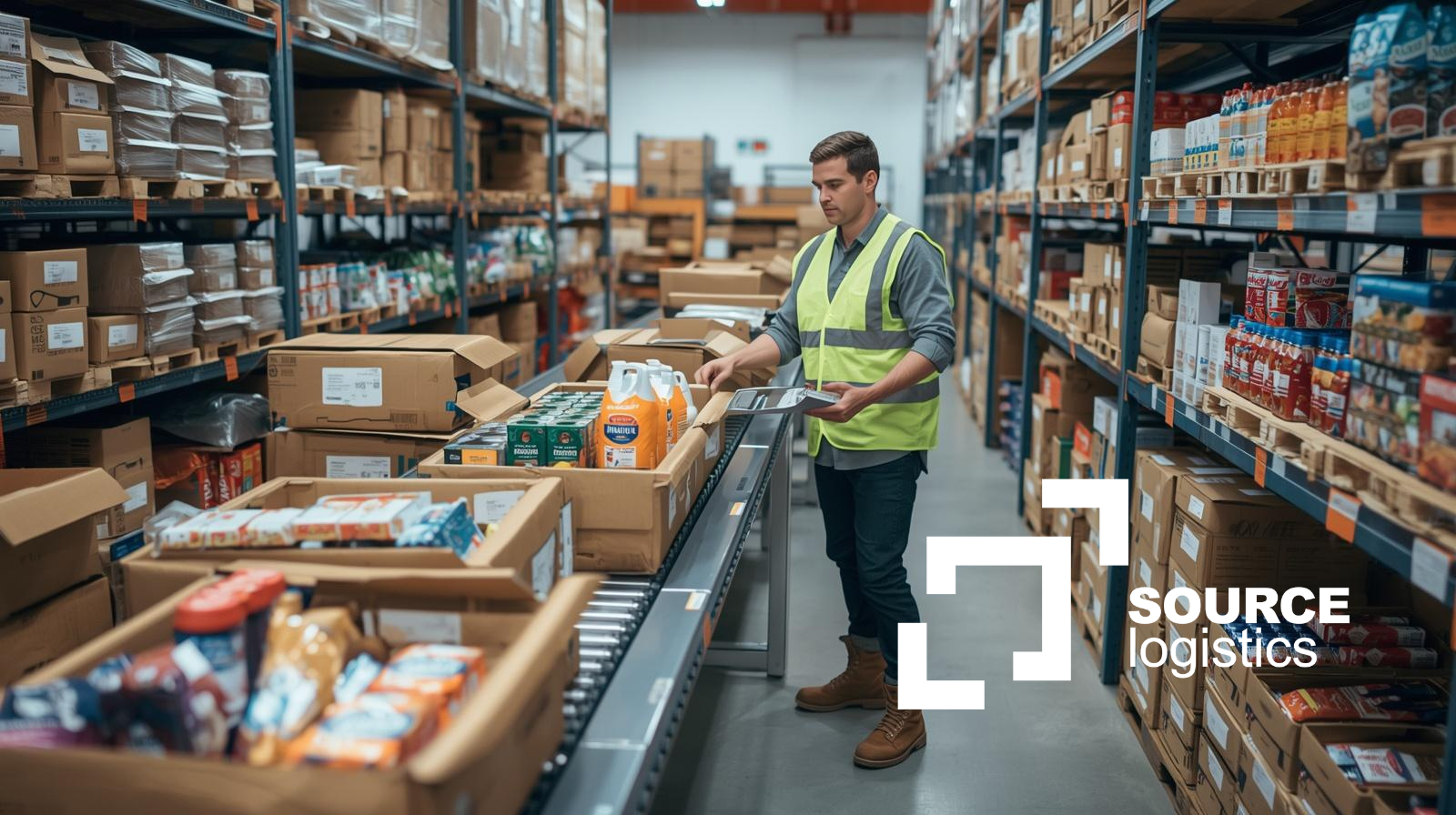
Warehousing and Distribution Services for Food and CPG Brands: A Practical Guide
By Source Logistics on Jun 22, 2026, 11:46:51 AM
.png)
Food and CPG brands operate under a different set of logistics pressures than most industries. Shelf-life windows, retailer compliance requirements, food safety audits, and seasonal demand swings leave almost no margin for a warehouse partner that treats your products like generic freight. This guide breaks down what warehousing and distribution services actually look like for food and CPG companies, what certifications and operational standards matter, and how to evaluate whether your current setup can support the growth you're planning.
What Makes Food-Grade Warehousing Different from Standard Storage
Food-grade warehousing is not simply a cleaner version of standard storage. It is a distinct operational environment governed by regulatory requirements, third-party audits, and retailer compliance standards that most conventional 3PL facilities cannot meet.
A food-grade warehouse must be registered with the FDA under the Food Safety Modernization Act (FSMA). That registration is a baseline, not a differentiator. What separates high-performing food-grade operations from compliant-but-mediocre ones is the layered system of controls they maintain: pest management programs, allergen segregation protocols, sanitation logs, and temperature monitoring at the zone and SKU level.
The Safe Quality Food (SQF) certification is the most recognized third-party standard in the industry. SQF Level 2 covers food safety plans and HACCP principles. SQF Level 3 adds a quality management layer, requiring documented continuous improvement programs and more rigorous audit performance. For brands selling into major grocery retailers, SQF Level 3 is increasingly the floor, not a premium option.
Beyond SQF, retailers impose their own requirements. Walmart, Kroger, Albertsons, and Costco each have specific expectations around pallet labeling, case marking, temperature documentation, and on-time, in-full (OTIF) performance. A warehouse partner that handles food but lacks experience with retailer compliance programs will cost you chargebacks and potentially shelf placement.
Core Warehousing and Distribution Services Food and CPG Brands Need
The warehousing and distribution services that food and CPG brands require break into four functional areas: storage, inventory control, distribution, and value-added execution.
Storage Environments
Most food and CPG SKUs require one of four storage environments: dry/ambient, refrigerated (34-40°F), frozen (0°F and below), or controlled atmosphere for certain produce categories. Not all 3PLs offer all four, and even fewer operate them within a single integrated facility that can handle a multi-temperature product portfolio without splitting inventory across multiple locations.
Multi-temperature capability matters because it eliminates transfer costs, keeps inventory data unified in a single WMS, and simplifies the inbound and outbound coordination that adds hours and errors when you're routing product across separate sites.
The biggest advantage comes when warehousing, inventory management, transportation, and value-added services operate within the same logistics ecosystem. An integrated approach reduces handoffs between providers, improves inventory visibility, and helps food and CPG brands maintain tighter control over product movement from receipt through final delivery.
Inventory Control and Traceability
Lot tracking and expiration date management are non-negotiable for food brands. In the event of a recall, your warehouse partner needs to be able to identify and isolate affected inventory within hours. That requires a WMS with lot-level traceability down to the individual case or unit, automated FEFO (first-expired, first-out) rotation logic, and regular cycle counts that catch discrepancies before they compound.
Reporting cadence also matters. Real-time inventory visibility through an integrated portal, combined with automated aging alerts and demand-based replenishment signals, gives your operations and sales teams the data they need to avoid both stockouts and write-offs from expired product.
When warehouse operations, transportation, and fulfillment systems are connected, inventory and shipment data can flow across the network in real time. That visibility helps brands make faster replenishment decisions and respond more effectively to changing demand.
Distribution for Retail and Omnichannel
Distribution logistics for food and CPG brands span a wide range of channels: grocery retail, club stores, foodservice distributors, ecommerce, and direct-to-consumer. Each channel has different cartonization, labeling, pallet configuration, and routing guide requirements.
A 3PL with deep food and CPG experience will have established SOPs for major retailer routing guides. That means shelf-ready labeling, pallet configurations that match retailer receiving specifications, and compliant advance ship notice (ASN) data transmitted via EDI before the truck arrives. Missing a retailer's receiving window or submitting a non-compliant pallet can trigger chargebacks that offset weeks of margin.
Ecommerce fulfillment for food adds the complexity of packaging requirements (humidity barriers, insulated shippers for refrigerated items) alongside standard pick accuracy and shipment speed expectations. These are not the same operational competencies. A warehouse that excels at pallet-in, pallet-out retail replenishment is not automatically equipped for unit-level ecommerce picking.
Value-Added Services
Retail-ready execution often requires value-added services that convert standard inventory into shelf-ready product: kitting multi-packs for club stores, applying retail ticketing and price stickers, assembling promotional displays, repacking single-SKU cases into variety packs, and performing quality inspections against retailer specifications. The closer these services are to your primary storage, the faster and cheaper the execution.
How Distribution Logistics Work Across a Nationwide Network
For food and CPG brands selling nationally, the geographic placement of your distribution network directly affects your landed cost, transit time, and retailer OTIF performance.
A single centralized warehouse may work for brands with concentrated regional distribution. But for companies replenishing retailers across multiple regions, a multi-node network with facilities near major population centers, port entry points, and production hubs reduces the average shipment distance and often cuts transit time by one to two days on cross-country lanes.
Strategic node placement also matters for cold chain continuity. Refrigerated shipments that transit too many transfers or cover too many miles see temperature excursions that compromise product integrity. Shortening the distribution leg protects your product and reduces the dwell time where temperature risk accumulates.
Cross-docking and transload capabilities at hub facilities allow inbound freight from manufacturers or importers to be sorted and re-outbounded to regional distribution points without being put away into long-term storage. For high-velocity SKUs with predictable demand, cross-docking reduces handling touches, cuts storage cost, and accelerates throughput.
What to Look for in a Food and CPG Warehousing Partner
Evaluating a warehousing and distribution partner for food and CPG products involves more than comparing square footage and rates. The following criteria separate partners that can support your growth from those that will create operational drag.
Certifications: SQF Level 3 and FDA registration are the baseline for food-grade environments. Look for additional certifications relevant to your product category: USDA-registered facilities for meat and poultry, organic handling certificates for organic SKUs, kosher or halal certifications if your products carry those designations.
Retailer compliance experience: Ask which major retailers the facility currently ships to and whether they have documented SOP libraries for those retailers' routing guides. A partner shipping to Kroger, Walmart, and Whole Foods has already built the muscle memory your products need.
WMS and integration capability: Your warehouse partner's WMS should integrate directly with your ERP, ecommerce platform, and EDI trading partners. Manual data transfer between systems is a source of error and delay. Ask whether the integration is pre-built or requires custom development, and who maintains it.
Bilingual operations capacity: For brands with LATAM manufacturing or import supply chains, a bilingual operations team significantly reduces communication errors at receiving and outbound. This is particularly relevant for brands routing freight through border crossings or working with Spanish-speaking contract manufacturers.
Temperature monitoring and documentation: Verify that facilities use continuous temperature monitoring with automated alerts, not manual spot checks. In a food safety audit, you need a documented temperature record for every day the product was in storage.
Customer retention and references: A 3PL's customer retention rate tells you more than their pitch deck. Ask for it directly. References from food or CPG brands in your size range, selling similar channels, will reveal operational realities that site tours do not.
The Relationship Between Warehousing and Operational Excellence
For food and CPG brands, warehousing is not a passive cost center. It is an active part of how you protect margin, maintain compliance, and deliver on customer commitments. The warehouse that loses a pallet, delays a retail shipment, or ships expired product does not just create a one-time problem. It creates chargebacks, a potential recall event, and a damaged retailer relationship that takes quarters to repair.
Operational excellence in food and CPG warehousing shows up in the details: a well-documented pest control log, a cycle count program that catches discrepancies before month-end, a receiving team that inspects inbound product against your quality specs before it goes into storage, and an outbound team that validates pallet configurations against the retailer routing guide before the truck backs in.
These are process disciplines, not technology features. The technology supports them. The people and the culture sustain them. When evaluating a warehouse partner, the question is not just what systems they use. It is how their team executes against those systems on a Tuesday afternoon when three trucks are arriving simultaneously.
Managing Seasonal Demand in Food and CPG Warehousing
Seasonal demand swings are one of the most operationally disruptive challenges for food and CPG brands. Holiday baking seasons drive flour, sugar, and shortening volumes up 40-60% in a six-week window. Back-to-school periods compress beverage and snack replenishment cycles. New product launches create short-burst demand that is difficult to forecast and even harder to execute without pre-positioned inventory.
Handling seasonal peaks without overcommitting to fixed warehouse capacity requires a partner with flexible storage arrangements and labor scalability. Fixed-term leases on dedicated warehouse space leave brands paying for empty square footage in slow periods and scrambling for overflow space during peaks. A 3PL with a multi-client network can flex capacity across its customer base, allocating more space and labor during your peak while drawing those resources from clients in their slow season.
The planning horizon matters as much as the physical capacity. Seasonal execution in food and CPG warehousing starts three to four months before the peak: confirming space allocations, ordering packaging materials for promotional kits, training warehouse staff on any new SKU configurations, and pre-positioning inventory in the regional nodes closest to peak demand. A warehouse partner that waits until eight weeks out to discuss capacity will leave you with constrained options and higher costs.
Import supply chains add another layer of complexity to seasonal planning. If your highest-velocity Q4 SKUs are manufactured overseas and arrive via ocean freight, the inbound window to U.S. distribution is fixed by vessel schedules. That means your warehousing partner needs to have the space, labor, and VAS capacity ready before the containers arrive, not after.
Compliance, Audits, and the Role of Your Warehouse Partner
Food and CPG brands face audits from multiple directions: FDA inspections, SQF third-party audits, retailer quality assessments, and internal quality team reviews. Your warehouse is a central part of every one of these.
An FDA inspection of a storage facility will focus on the physical environment (pest control evidence, sanitation records, temperature logs), product handling procedures, and whether the facility's FSMA food safety plan is current and followed. A well-run 3PL maintains continuous audit readiness rather than scrambling when an inspection is announced.
Retailer quality assessments often happen unannounced. Walmart's supplier quality program, for example, includes periodic facility reviews where they evaluate cleanliness, organization, labeling accuracy, and temperature compliance. A warehouse partner that has been through multiple cycles of retailer assessments has already built the SOPs and housekeeping standards those assessments require.
SQF audits happen annually and require documented evidence of your food safety management system, including corrective action logs, training records, and internal audit reports. The score your warehouse earns in an SQF audit can affect your standing with retailers who require minimum SQF performance thresholds from their supply chain partners.
Working with a warehouse partner that is already SQF Level 3 certified and maintains a robust audit documentation system protects your brand. If your warehouse fails an SQF audit or an FDA inspection, the consequences can include temporary suspension of operations, product holds, and public disclosure of inspection findings. The awards and certifications your warehouse partner maintains are not marketing credentials. They are operational evidence of how the facility is run.
Getting Started with Food-Grade Warehousing and Distribution
Most food and CPG brands begin evaluating warehouse partners when they have outgrown their current setup, are expanding into new retail channels, or are taking on a manufacturing supplier in a new geography that changes their inbound freight network.
The right starting point is a logistics review that maps your current inventory locations, distribution points, transit lanes, and retailer compliance requirements against your sales projections for the next 12 to 24 months. That map will surface the capacity gaps, compliance risks, and cost inefficiencies that a new or expanded warehouse partnership needs to address.
Source Logistics operates more than 25 food-grade facilities across the U.S., all SQF Level 3 certified and FDA-registered, with integrated value-added services, temperature-controlled storage, and bilingual operations support. To discuss your product mix, channel requirements, and distribution footprint, contact the Source Logistics team.
You May Also Like
These Related Stories
The Freshness Factor: How Warehouse Location Impacts Food Quality, Freight Costs, and Retail Compliance
The Midwest Capacity Trap: How to Prepare for Peak Season Without Overbuilding