Over the past several years, private equity has moved aggressively into third-party logistics.
The thesis is straightforward: fragmented regional operators, steady demand tied to consumption, and multiple levers for value creation through consolidation and scale.
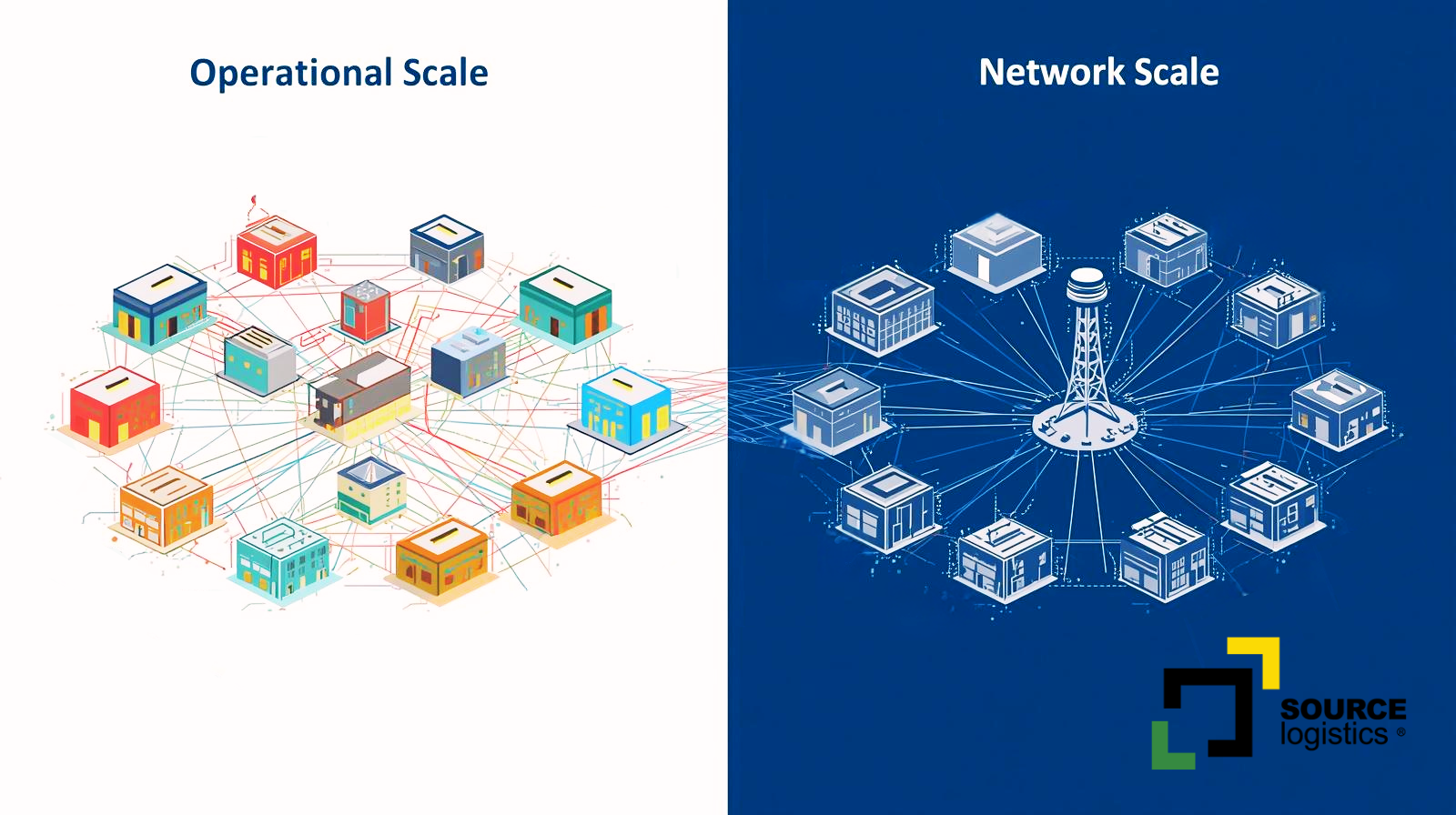
But there’s a gap emerging inside many of these platforms, one that doesn’t show up in initial deal models: Operational scale is increasing, but network scale often isn’t.
And that distinction is starting to matter more.
Conversations leading into industry events like the IWLA Convention & Expo reflect this shift clearly. Operators and investors aren’t just asking how to grow networks. They’re asking how to make them operate as a system.
Bigger Doesn’t Always Mean More Aligned
Adding facilities expands footprint. Adding customers grows revenue. Adding services increases capability. But those moves don’t automatically create a cohesive network.
Instead, many platforms end up with:
- Different WMS and TMS environments across sites
- Inconsistent operating procedures and service models
- Fragmented visibility into inventory, transportation, and performance
- Varying labor structure and productivity standards
Each individual piece may perform well on its own, but together they don’t behave like a unified system. That’s the difference between scale and coordination.
Why the Gap is Getting Harder to Ignore
This wasn’t always a problem. For years, growth masked inconsistency. As long as volumes were rising and customers were being served, integration could wait.
That environment is changing. According to McKinsey & Company, supply chain leaders are increasingly prioritizing resilience, visibility, and end-to-end coordination, not just capacity expansion. More recent analysis from KPMG reinforces that shift, noting that growing disruption, regionalization, and multi-node operating models are now putting pressure on organizations to coordinate across increasingly distributed supply chains.
In that environment:
- Customers expect consistency across facilities, not just capability
- Services failures in one node impact the credibility of the entire network
- Lack of integration shows up in margin volatility and missed SLAs.
What used to be operational noise is now a strategic risk.
Where Scale Starts to Break Down
Most roll-up strategies assume that scale will drive efficiency over time. But without alignment, scale can introduce friction faster than it creates value.
It usually doesn’t show up all at once. It builds gradually.
A customer moves into a second facility and the experience feels different. Reporting takes longer because data lives in multiple systems. Operational decisions slow down because there isn’t a single source of truth. What “good” looks like starts to vary depending on location.
None of these issues are catastrophic on their own, but together they create drag, and that drag compounds as the network grows.
Why This Becomes a Diligence Issue
At a certain point, these gaps stop being internal challenges and start becoming visible externally.
Buyers see it in inconsistent margins across locations. They see it in customer concentration tied to specific facilities instead of the network. They see it in how difficult it is to explain how the platform actually operates as a system.
And that changes the conversation: The question is no longer just how much the business has grown, but also how reliably it can operate at scale.
Network Scale is Built, Not Acquired
A true logistics network isn’t just a collection of locations.
It’s a system that behaves consistently, across facilities, across customers, and across services.
Processes align, systems communicate, performance is visible, and execution is repeatable.
That’s what allows a platform to move customers seamlessly, absorb variability, and scale without breaking. And ultimately, that’s what turns growth into enterprise value.
Where the Right Partner Changes the Equation
This is where the role of a partner like Source Logistics becomes more relevant. Not simply as a service provider, but as a part of the operating layer that helps unify the network.
Through integrated warehousing, fulfillment, and transportation capabilities, Source supports alignment across facilities, consistency in execution, and visibility across the network.
The goal isn’t just to add capacity. It’s to allow the network to grow without adding strain. Because growth is rarely the constraint, friction is.
The Platforms That Win Will Look Different
The next generation of successful 3PL platforms won’t just be larger. They’ll be more coordinated, consistent, and transparent in how they operate.
Buyers are already underwriting toward that reality. The question is shifting from “How big is the network?” to “How well does it actually function as a network?”
That’s a higher bar, and one that exposes gaps quickly.
Scale With Source
If you’re evaluating how to scale a logistics platform, or preparing for the next phase of growth or exit, it is worth taking a closer look at how your network actually operates.
Explore how Source helps logistics networks scale without added strain, and connect directly with Marcelo Sada, President/Corporate Development to discuss where alignment may be limiting scale. Learn more and connect.
.png)